

By modifying the prices of materials, labor, and equipment at construction project sites, a ZIP code construction cost estimate helps contractors create more accurate budget estimates. The labor-intensive design is, however, not that similar in price for different markets. This is because of the local wage levels, availability of suppliers, and transport needs. Moreover, there are different requirements for construction and designs in different offices. A ZIP code is a good starting point, but it is not a guarantee, which is why many contractors turn to Digital Estimating for detailed, location-specific cost estimates.
The drawings haven’t changed. Why is the price different?
When contractors move a project into another market, familiar unit rates can become unreliable. A ZIP code construction cost estimate accounts for regional differences, but the location field alone doesn’t produce a bid-ready number.
Direct Answer Box
A ZIP code construction cost estimate is prepared by pricing a defined scope of construction using locality-adjusted prices for materials, labor, and equipment. There are regional differences in cost estimates due to differences in wage costs, access to suppliers, delivery circumstances, and contractor availability. A pricing area is chosen by a ZIP code, but quantities and current quotes, plus site conditions, determine if that base will work.
What is the meaning of construction pricing by ZIP code?
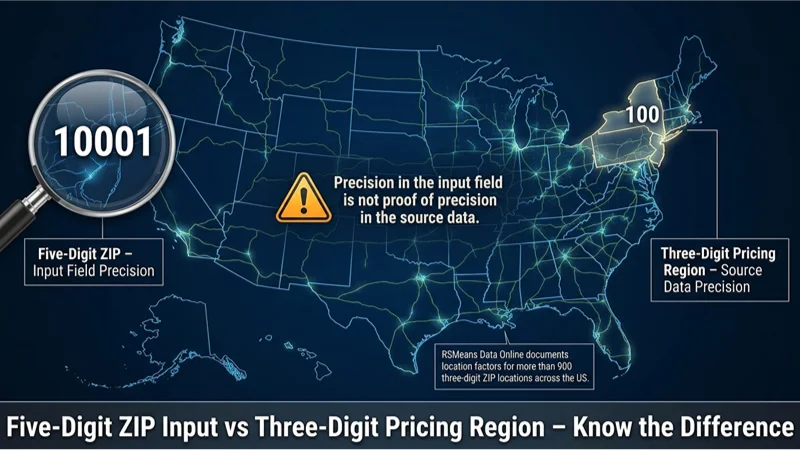
It means connecting project quantities to an appropriate local pricing baseline instead of applying the same national rates everywhere. But there’s an important distinction. A calculator can accept all five ZIP digits while using a broader pricing region underneath. RSMeans Data Online, for example, documents location factors for more than 900 three-digit ZIP locations across the United States. That does not mean every five-digit ZIP has its own independently measured price list. Ask which pricing area your address maps to. Precision in the input field is not proof of precision in the source data. This matters most in public bid estimating, where a pricing baseline that doesn’t reflect local conditions can push a bid too high to win or too low to profit.
Why regional construction pricing changes your estimate
Labor rates are only half the calculation.
An hourly rate indicates the cost of time. The term “productivity” describes how much time the work needs. As a consequence, labor pricing should differentiate the labor basis chosen from installation hours. RSMeans categorizes labor types as standard union, open shop, residential, and repair and remodeling data. Selecting the wrong labor basis will impair an otherwise good estimate. An example installation takes 100 hours to perform and is charged $60/hour. Complete labor: $6,000. A restricted access rise in demand to 125 hours at the same hourly rate yields $7500. The wage didn’t change. The working conditions did.
Materials arrive at a jobsite, not a national average.
A supplier’s unit price is only part of the purchasing decision. Freight distance, local availability, and delivery access can change what material costs at the project. Transportation costs can cause labor efficiency losses in distant areas. Check the material price for delivery, unloading, and taxes, and specify the quantity. Otherwise, two comparable quotes could cover different liabilities.
Location can change the required work.
Adjusting for sectors and adjusting for scope are two different tasks. The construction specifications may be modified due to seismic, wind, energy, and other factors. Work required at any given site can vary due to soil and access conditions. The differences demand revised quantities or assemblies and not just a percentage added to the basic design. Which is why it helps to understand unit price vs assembly estimating before you adjust any numbers. Price the correct scope first. Localize it second.
How to calculate a location-adjusted estimate
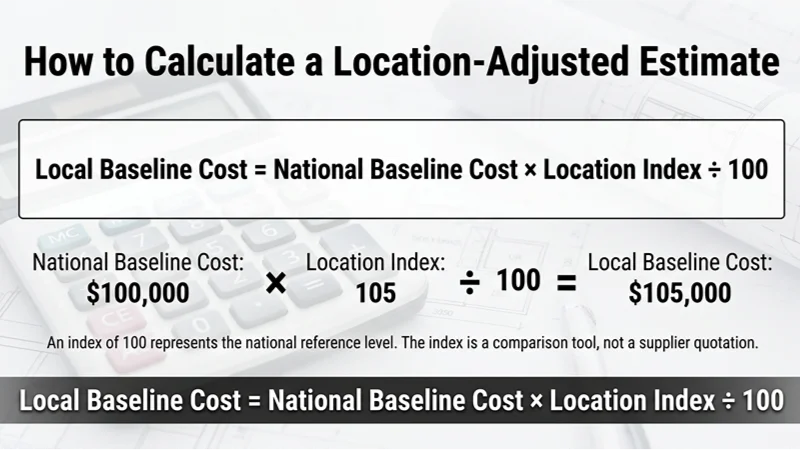
For an appropriate national baseline, a preliminary adjustment follows this relationship:
Local baseline cost = National baseline cost × Location index ÷ 100.
An index of 100 represents the national reference level. The index is a comparison tool, not a supplier quotation or a guarantee of the final project price.
For detailed work, examine material, labor, and equipment separately where suitable component factors are available.
Worked example: identical scope, different pricing factors
The following figures are illustrative, not published rates for particular cities.
Our comparison starts with $50,000 in materials, $40,000 in labor, and $10,000 in equipment. The national baseline totals $100,000.
-
Market A assumes comparable multipliers of materials to be 1.02 and 0.90 for labor and 1.00 for equipment. The subtotal after adjustment is $97,000.
-
Market B utilizes assumed multipliers of 1.05 for materials, 1.25 for labor, and 1.10 for equipment. The subtotal, when adjusted, is $113,500.
The difference is $16500 before project-specific additions.
The reviews should not include freight, installation, overhead, or profit, or anything like it. An estimate is easier to defend if we show where each adjustment starts and where it finishes.
The mistake that can inflate a local estimate
Don’t localize the same cost twice. Suppose a supplier provides a current delivered price of $20,000 for the specified materials at your project address. Applying another assumed location factor of 1.08 raises that line to $21,600. That extra $1,600 needs justification.
Adjust an applicable baseline using a location factor. Rather than automatically using the same adjustment again, when an equivalent current local quotation replaces that baseline, record the substitution. The freight, installation, overhead, or profit should not appear elsewhere in the reviews. We can make an estimate easier to defend by showing where each adjustment begins and where it ends.
What contractors should request from an estimating service?
“Priced to your ZIP code” should start the conversation, not finish it.
Request an estimate basis that identifies:
-
The project address and pricing region used.
-
The database release or pricing date.
-
Quantities, specifications, and scope exclusions.
-
Labor type and productivity assumptions.
- Supplier quotation dates and expiration conditions.
Treatment of freight, fees, overhead, profit, escalation, and contingency.
Timing should not be linked to geography. A location index attributes a cost relationship to locations, whereas escalation refers to changing costs over time. One situation does not necessarily resolve the other. To gain more context, check Digital Estimating’s estimating guide for construction costing. Whether it is for homes, additions, or renovations, check out its residential estimating service and confirm the deliverables first before commissioning an estimate.
Frequently Asked Questions
How can I calculate building costs by ZIP code?
Determine the limits of the project and measure the quantities. Select a suitable regional pricing baseline. Validate important items with current local quotes. Next, mention site conditions and clearly identify exclusions.
2. Is a ZIP code construction estimate better than a national average?
It can provide a better initial position. Ultimately, accuracy is determined by the underlying data, age and specifications of the project, and how closely local conditions match the assumptions.
3. Is it possible for two projects located within one ZIP code to cost different amounts?
Affirmative. The conditions of foundations, design complexities, finishes, access, and scope will vary from neighborhood to neighborhood. Just because they have the same ZIP code, it doesn’t make the projects equivalent.
4. Does RSMeans provide separate pricing for every five-digit ZIP code?
Their online guide provides location characteristics for over 900 US 3-digit ZIPs. Inquire about the mapping of your total address to the pricing area you have chosen.
5. Can permits and land be part of location factors?
Avoid presuming that they do. An index of the construction site compares construction inputs; check permits, land, design fees, and other items from the budget separately against the estimate scope.
6. Can I place a bid through an online construction calculator?
Consider a wide calculator as an early shaping tool for a budget unless its scope and supporting detail meet the bid requirements. Before committing, review quantities, specifications, exclusions, subcontractor coverage, and current pricing. A good estimate does not only identify your location. It indicates which prices were modified, which ones were validated, and which assumptions still require action.
