
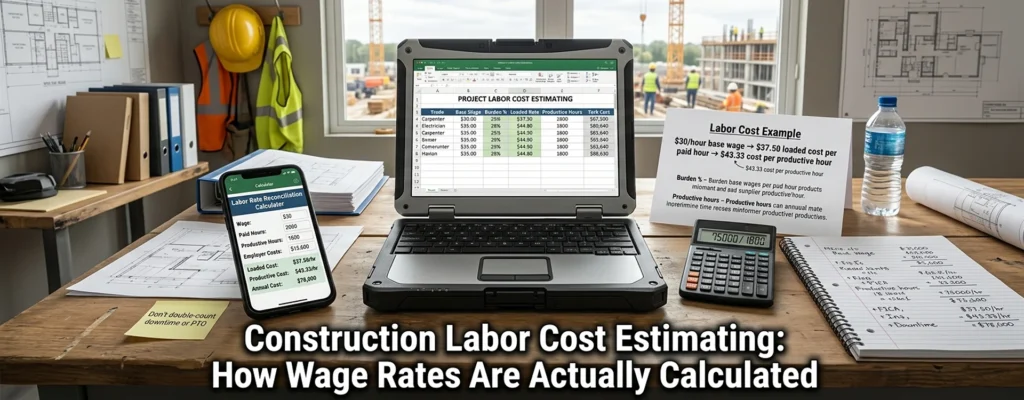
A $30 hourly wage isn’t a $30 labor cost. But adding a standard burden percentage won’t automatically give you a dependable estimate either. In order to estimate construction labor costs, general contractors make three interrelated decisions: what wage applies, what employment costs it excludes, and what quantity of accurately defined labor hours the scope requires. Commercial estimating services price each of these separately, with labor hours broken out by trade.
Direct Answer Box
Construction labor cost estimating involves calculating the cost incurred by the employer for the workforce to complete a specified scope. Calculate the applicable wage for each category of worker, add in the employer’s costs, then multiply the resulting hourly cost by the appropriate estimated hours. Add separately budgeted supervision or other labor costs only once.
Use these relationships:
-
Burden percentage = additional employer costs ÷ gross wages × 100.
-
Loaded cost per paid hour = total employment cost ÷ paid hours.
-
Cost per productive hour = total employment cost ÷ productive hours.
-
Task labor cost = matching hourly cost × estimated task hours.
The word “matching” matters. The downtime allowance for a rate calculated per actual hour of productivity must not be double-counted for further hours.
How Contractors Determine the Core Pay.
Labor is only one line in the wider construction estimating process. Begin with the employee and the task. Ascertain the trade, type, experience level, site location, and date of work. A foreman, journeyworker, and apprentice should not have the same estimating rate. Use payroll records for employees in current use. For new hiring, compare local recruiting evidence with occupational compensation benchmarks. Then check applicable contract wage requirements before settling on the estimate input.
Use Construction Wage Rates by State as Benchmarks
The BLS Occupational Employment and Wage Statistics measure wage estimates at one of several levels: occupation, state, and metropolitan or nonmetropolitan. Consequently, the information is useful in verifying state construction wage rates, but a statewide figure is not a quote for your specific crew. Note the profession, location, time span, and value used. Refrain from contrasting one state’s median with that of another state’s mean whilst calling the difference a location adjustment.
Evidence of the market should be kept distinct from contractual requirements. Davis-Bacon wage determinations set a base hourly wage and fringe benefit obligation for applicable classifications on covered work.

What Labor Burden Includes
Labor burden construction calculations capture employer costs beyond gross wages. Payroll taxes on employers, workers’ compensation, health insurance, and retirement contributions are all common components of employee benefit costs as well as appropriately allocable training costs.
Construct your calculations using the actual records and not a borrowed percentage. Wages follow separate costs and costs allocated across hours. A health premium paid monthly and an insurance charge deducted from payroll do not relate to overtime the same way. Using one single multiplier is convenient, but the assumptions must be visible.
Keep overhead and profit distinct. If you recover an employment expense inside the labor rate, don’t recover it again through overhead markup. Procore explicitly identifies this duplicate recovery problem. At Digital Estimating & Architecture, keep labor and overhead as separate, visible line items so every number can be traced and defended.
A Worked Example: From $30 Wages to Installation Cost
Consider a base wage of $30, paid annual hours of 2080, and additional employer costs of $15600. Employer’s gross wages already encompass paid leave. We can consider 1,800 productive hours after leave, training, etc.
The number is.
Yearly salary: $30 multiplied by 2,080 = $62,400.
Overall cost of employment: $62,400 + $15,600 = $78,000.
Cost per hour on a loaded basis: $78,000 ÷ 2080 = $37.50
Cost per productive hour is $78,000/1800 = $43.33.
The worker continues to earn $30 hourly. The contractor needs approximately $43.33 per productive hour to recover this assumed employment cost. Now suppose an installation needs 100 productive worker hours. Its labor allowance is approximately $4,333 using the unrounded rate.
There’s another valid route. Convert those 100 productive hours into approximately 115.56 paid hours using the same utilization assumption, then multiply by $37.50. Both routes reach the same cost. Don’t combine them. Applying the productive hourly rate to the expanded paid hours would recover the same lost time twice. Also, don’t add paid leave wages again when they are already included in annual gross wages. The denominator adjustment already spreads that existing cost across fewer productive hours.
Crew Cost Is Not Worker Cost
Suppose three workers have loaded rates of $50, $42, and $34 per paid hour. Their combined crew cost is $126 per crew hour. If that crew installs 180 linear feet during eight paid hours, labor costs $1,008, or $5.60 per linear foot. Those eight crew hours represent 24 worker hours. Multiplying $126 by 24 would triple the estimate.
This distinction matters when comparing subcontractor proposals, production records, and estimating databases. Confirm whether each productivity figure measures output per crew hour or per individual labor hour before applying a rate. Deltek’s unit estimating approach likewise connects measured quantities with labor hours and hourly cost.

Wage and overtime treatment must be separate.
On Davis-Bacon work covered under the law, the prevailing wage is the sum of the basic pay and any applicable fringes. Contractors can fulfill this obligation by using acceptable benefits, cash, or a permissible combination. Don’t automatically multiply the entire package by 1.5. For illustration, assume $40 basic pay, a $15 qualifying fringe contribution, and an applicable overtime premium of half the basic rate. That overtime hour’s cost to employers would be $75 before any other employer expenses: $60 for wages plus $15 fringe.
According to the Department of Labor, fringes are still owed if an employee works overtime. However, the additional half-time does not usually apply to any qualifying fringe contributions or properly identified cash paid in their stead. Check the actual regular rate and governing requirements before quoting.
What to Expect From a Labor Estimating Service
A useful service should deliver more than one total. Provide a rate build showing classifications, wage evidence, burden components, hour definitions, productivity assumptions, overtime exposure, and exclusions. Assess providers regarding their audit capabilities. A calculation justifiable by your project team matters more than a seemingly exact figure. When requesting a review for an estimate, submit drawings, scope boundaries, location, schedule, proposed crew, and available payroll or production records.
FAQS
What is the method for calculating construction labor cost?
Take each classification’s loaded hour cost times its corresponding estimated hours, add up the classifications, and allocate labor items separately.
How Wage and Labor Cost Differ from Each Other?
“Wage” refers to an employee’s pay. Employer’s expenses, such as taxes, insurance, and benefits, are included in labor costs.
Where can I find construction worker wages by state?
Reference BLS occupational wage tables for geographic benchmarks, then verify current local hiring conditions and applicable project wage requirements.
Is there a standard construction labor burden rate?
Every contractor doesn’t fit the same percentage. You calculate it from your own classification, insurance, payroll, and benefit records.
Should I multiply the total labor hours by the crew size?
Those hours are not declared per worker only. If total worker hours are present in an estimate, multiplying by crew size will double its count.
Is Profit Included in the Loaded Labor Rate?
Not at all. Employer price and selling price are two different calculations; overhead recovery and profit may be identified separately.
Recommended Tool: Labor Rate Reconciliation Calculator
Provide inputs for wage, classification, annual paid hours, productive hours, employer costs, crew composition, and installation output.
Show paid hour cost, productive hour cost, crew cost, and installed unit cost together. Add warnings for duplicate PTO, repeated downtime allowances, and ambiguous crew hours. Let users view results before an optional “Request an estimate review” form.
