

AI construction estimating helps contractors speed up plan review, draft quantity takeoffs, find drawing details, and organize early bid work. In 2026, the most practical use is not letting software price a job unattended. It is using AI to produce a faster first pass, then having a qualified estimator validate scope, quantities, labor, pricing, and bid terms.
For estimators handling more invitations to bid than their team can reasonably pursue, that first pass matters. A platform can identify doors, rooms, walls, symbols, areas, and linear measurements from a digital plan set. It can also help sort sheets, search drawings, and flag a revision that may affect the takeoff. Those are meaningful time savers. They are not a substitute for reading specifications or understanding how the work will actually be built.
AI construction estimating is therefore becoming a workflow tool. Contractors use it to remove repetitive measurement work so their estimators can spend more time on exclusions, subcontractor coverage, labor productivity, procurement risk, and the final bid strategy.
What contractors use AI for
The most useful AI features tend to sit near the beginning of preconstruction, where volume and repetition are highest.
- Automated quantity takeoffs: AI takeoff software can identify common plan elements and create editable counts, areas, and linear measurements from uploaded drawings. This works best where plan symbols and scales are consistent.
- Plan navigation and search: Instead of manually opening dozens of sheets, estimators can search for a room, detail, note, or component. That is especially useful when addenda arrive late and the team needs to identify affected areas quickly.
- Early budget support: Teams may use quantities from an AI generated first pass to scope a preliminary budget. The estimator still needs current local prices, production assumptions, waste factors, equipment, overhead, and contingency.
- Bid organization: AI construction bidding tools can help turn reviewed quantities into a bill of quantities, proposal draft, or bid checklist. The submitted proposal still needs a human review of exclusions, alternates, allowances, and owner requirements.
Current product offerings reflect this split. ConstructConnect describes AI features such as automatic takeoffs, counts, plan setup, and plan questions across several estimating products. Its own buyer guidance also tells contractors to trial tools on their own plans and ask how easily incorrect AI generated measurements can be corrected.
A safer estimating workflow
A useful rule is simple: let AI draft the measurable work, but let accountable people approve the commercial commitment.
| Estimating stage | Appropriate AI role | Human review required |
|---|---|---|
| Bid qualification | Summarize plans and locate key documents | Decide whether the job fits capacity, risk appetite, bonding, and schedule |
| Quantity takeoff | Count repeatable items and measure areas or linear feet | Check scale, scope boundaries, drawing notes, alternates, and omissions |
| Cost build up | Populate templates and organize assemblies | Update supplier quotes, labor productivity, equipment, waste, tax, markup, and contingency |
| Addenda review | Compare changed sheets and flag possible impacts | Confirm every change and revise affected scope |
| Proposal preparation | Draft a bid form or client proposal | Approve price, exclusions, qualifications, duration, and authorized signature |
This framework matters because a clean vector PDF and a messy scanned plan are not equal inputs. AI may perform well when drawings are legible and repetitive. It is more likely to miss work where symbols are project specific, drawings are poor quality, plans contain hand markups, or systems overlap. Dense MEP coordination, site utilities, demolition notes, and custom assemblies deserve close estimator review.
The biggest mistake: treating takeoff as pricing
A takeoff answers, “How much material or work appears on the plans?” An estimate answers, “What will it cost this company to perform that work under these project conditions?”
Those are different questions.
A drywall subcontractor, for example, may get wall area and door counts from AI takeoff software. But the final estimate still depends on wall type, height, stud gauge, shaft wall conditions, insulation, fire ratings, access, crew production, stocking, lift rental, waste, schedule compression, and supplier pricing. A missed note on a partition type can matter more than a fast count.
That is why contractors should preserve a traceable link between the final line item and the drawing or specification that supports it. When a project manager asks why a number changed, the estimator should be able to show the sheet, detail, quote, assumption, and revision behind the price.

State and project rules change the estimate
AI can organize data, but it cannot safely decide legal or project specific labor requirements on its own.
For public works, wage rules can materially change a bid. In California, prevailing wage requirements apply to covered public works, and the applicable rate is tied to the craft or classification and local labor market. California’s Department of Industrial Relations says bidders on public works must use the required wage rates, with separate determinations and effective dates that need review.
New York also maintains prevailing wage schedules for public construction, with schedules issued by county and project type. A contractor bidding in Albany may therefore need different wage inputs than a contractor pricing comparable work in the Bronx.
On federally funded construction, contractors may also need to assess Davis Bacon requirements, project wage determinations, and bid documents. A qualified estimator, payroll specialist, or construction attorney should review public works classifications and wage obligations before the bid is submitted. AI can help retrieve documents, but it should not be the final authority.
How to test AI takeoff software
Do not choose a tool based on a polished demo. Run a controlled pilot.
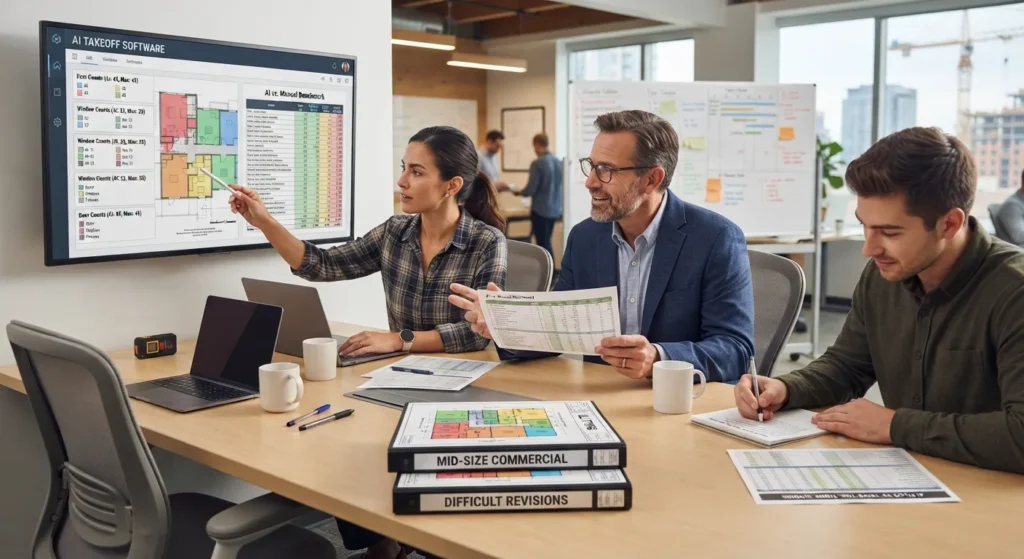
- Select three completed projects that represent your normal work, such as a small tenant improvement, a mid size commercial project, and a difficult plan set with revisions.
- Create a manual benchmark using your accepted final takeoff and estimate, not an early draft that was later corrected.
- Run the same plans through the AI tool and compare counts, square footage, linear footage, and item classifications.
- Record where the system saved time and where it created rework. A fast output that requires extensive correction may not improve your real bid cycle.
- Check the full cost of adoption, including seats, training, integrations, document storage, and whether the tool fits your Excel, accounting, bid management, or project management process.
NIST’s AI Risk Management Framework provides a useful lens for this pilot. Its four functions are Govern, Map, Measure, and Manage. For an estimating team, that means defining who owns the final estimate, identifying where errors could occur, measuring performance against known jobs, and maintaining a process to correct issues.
FAQ
What is AI construction estimating?
AI construction estimating uses machine learning and computer vision features to help contractors interpret plans, extract quantities, organize estimating data, and prepare bid materials. In most real workflows, it supports an estimator rather than replacing one. The final estimate still requires verified scope, local pricing, labor assumptions, overhead, risk allowances, and approval by someone accountable for the bid.
Can AI do construction takeoffs?
Yes. AI can perform parts of a construction takeoff, particularly counts, areas, linear measurements, room recognition, and searches across digital plan sets. Results are generally more useful on clear, consistent drawings than on scans, unusual symbols, dense MEP designs, or incomplete documents. Every AI generated takeoff should remain editable and receive a human quality check.
How accurate is AI takeoff software?
Accuracy depends on the plan quality, trade, item type, and tool configuration. A vendor claim is not proof that the software will work equally well on your own projects. Test it against completed work where you know the accepted quantities. Measure both variance and review time, because an accurate count that takes too long to verify may not improve productivity.
Can AI create a complete construction estimate?
Not reliably by itself. AI may help create quantities and draft estimating inputs, but it does not inherently know your crew productivity, supplier quotes, negotiated labor rates, project access constraints, field conditions, contract risk, or markup policy. It should support the cost build up, while an experienced estimator owns the estimate and final proposal.
What is the best AI estimating software for contractors?
The best option depends on the trade, project type, existing software, plan quality, and team size. STACK, PlanSwift, On Screen Takeoff, Togal.AI, Procore Estimating, and other platforms serve different workflows. Use your own plans in a pilot, confirm integrations, and verify whether the feature is true automated takeoff, plan search, BIM based measurement, or an outsourced takeoff service.
Does AI construction bidding software help contractors win more bids?
It can help contractors respond faster and pursue more qualified opportunities, but it cannot guarantee more wins. Winning depends on scope accuracy, pricing, relationships, capacity, schedule, qualifications, and project fit. The strongest use of AI construction bidding is to reduce repetitive work so estimators can spend more time improving the assumptions that protect margin.
What should contractors check before using AI estimating software?
Check how the system handles plan revisions, scaling, incomplete drawings, trade specific symbols, and user corrections. Confirm who owns uploaded plan data, whether the platform integrates with your current stack, and whether every output can be traced back to a sheet and detail. Establish a written review process before any AI generated quantity reaches a client proposal.
AI construction estimating works best as a disciplined first draft, not an autopilot bid desk. Start with one trade, one estimator, and several historical projects. Compare AI assisted quantities with accepted manual takeoffs, document the exceptions, and keep final pricing under experienced human control. Then expand only after the workflow consistently saves time without weakening the accuracy and defensibility of your bids.
