
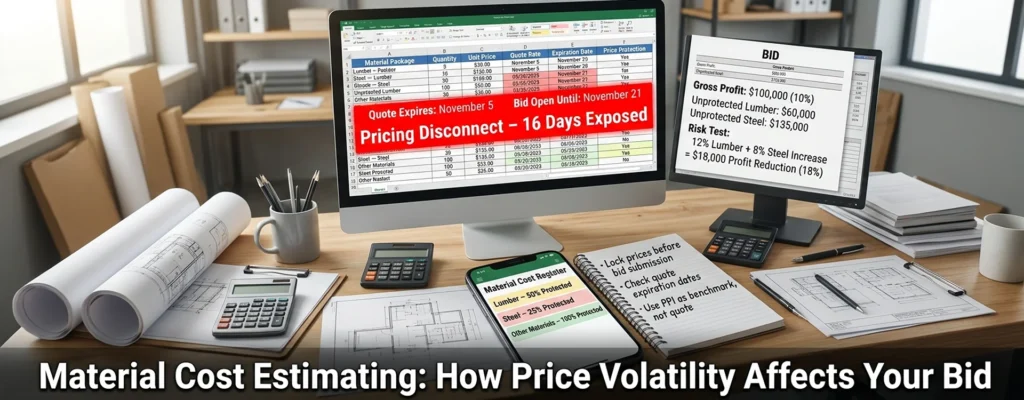
Your takeoff can be correct while your bid can be wrong. The gap frequently arises post-submission, as supplier pricing runs out before terms of purchase are secured.Estimating material costs in construction requires more than just a current unit price. The record must specify what the price covers, when it will expire, and who will bear any increase before procurement. Supplier quotes and delivery requirements, as well as documented assumptions, should go in the same construction estimating workflow.
Direct Answer Box
The volatility in the price of materials interferes with your bid when the price you pay ultimately differs from the material cost in your estimate. Make sure the overall bid is protected by checking expiration dates of the quotes, looking for purchases without binding protection on the price, testing package-specific increases, and agreeing on the nature of adjustments that will be considered eligible. The key question isn’t simply, “What does steel cost today?” It’s, “How much steel spending remains exposed when we can actually commit to buying it?”
Why a Current Quote Can Still Leave You Exposed
A quote from the suppliers and a contractor’s GC and subcontractor bid support package may not be valid for the same period. SimplyWise recommends timing the bid window to the supplier’s assistance rather than choosing an expiry date by default.
Look at an example. Your supplier provided a quote on October 22. This quote expires on November 5. The owner expects your bid to be open until November 21. Procurement cannot proceed until an outstanding approval is resolved.
There’s a disconnect in pricing.
Before submission, inquire what generates a binding price commitment, what conditions allow for repricing, and if freight or other charges remain adjustable. Note those answers rather than taking for granted that award automatically shields your buying cost. According to Procore, you should keep quotes, purchase orders, and supporting documents for this type of price review.
Create the Estimate Based on Available Packages.
Start with quantities, then normalize the quote.
A reliable estimate starts with the specified material and measured quantity. Supplier comparisons should then reflect equivalent scope, delivery requirements, and purchasing units. Autodesk specifically recommends verifying delivery fees, lead times, and quote documentation.
For each major package, record:
-
Drawing revision, material specification, and quantity.
-
Purchasing unit and any separately stated waste allowance.
-
Supplier, quote date, and expiration.
-
Included freight, taxes, and excluded charges.
-
Planned commitment date and delivery date.
-
Price protection conditions and responsible reviewer.
This register gives the estimator and procurement team one set of assumptions to check.

Treat lumber and steel separately.
Differentiate dimensional lumber from engineered wood products. Check whether raw material, fabrication, coatings, freight, or installation is included in the quoted scope for steel. Two apparently similar totals may involve different purchasing obligations.
Profit at Risk Calculation.
This is a sensitivity test for illustration purposes only, not a market or client result. A general contractor costs $100,000. In a cost-plus contract, specified charges would be paid plus a profit. A gross profit of $100,000 is expected, indicating a gross margin of 10% before excluded costs.
The material budget contains three packages:
-
Lumber: $120,000, with 50% protected.
-
Steel: $180,000, with 25% protected.
-
Other materials: $100,000, fully protected.
Unprotected lumber spending is $60,000. Unprotected steel spending is $135,000. Now test a 12% lumber increase and an 8% steel increase. Lumber adds $7,200; steel adds $10,800. Together, they add $18,000. Assuming unchanged revenue, no recovery, and no other cost changes, gross profit falls to $82,000. Gross margin drops to 8.2%. That is an 18% reduction in expected gross profit.
The calculation is straightforward: unprotected package cost multiplied by the assumed price increase. Its value comes from applying the assumption only to spending that remains exposed, rather than automatically escalating the entire material budget.
Use Indexes Without Mistaking Them for Quotes
The BLS Producer Price Index measures changes in selling prices received by domestic producers. It does not provide your project’s delivered supplier price. ENR also warns that its construction indexes represent a limited basket of materials and labor, not every factor affecting a project. Its city indexes aren’t intended to measure cost differences between cities.
Use indexes to challenge stale assumptions about volatile material prices, which are among the most common construction estimating mistakes, and to support agreed adjustment methods. Confirm the purchasing number with suppliers. Past movement is evidence, not a promise about the next purchasing period.
Select the Appropriate Protection.
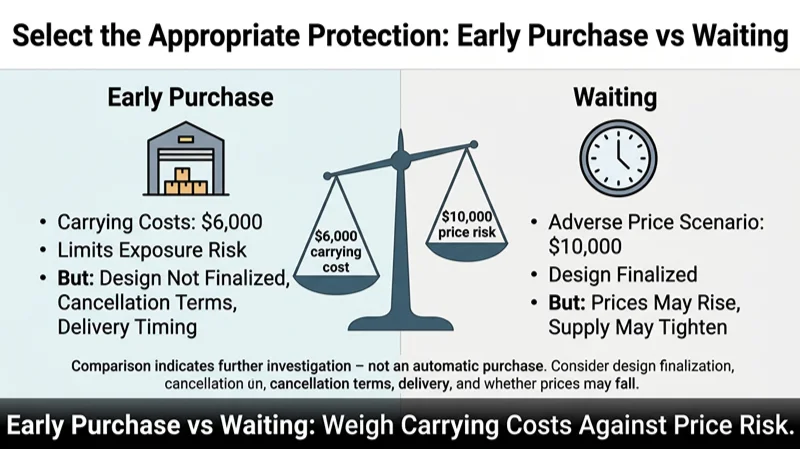
Evaluate the early purchase with the total cost. Purchasing sooner rather than later may limit exposure risk but can also lead to other costs. ABC Carolinas expressly suggests weighing the cost of carrying inventory against material increases. The carrying costs of moving the package are $6,000 total if you get it early. Waiting to claim your price has a worst-case cost of $10,000. Comparison indicates further investigation and not an automatic purchase. Finalize the design, cancellation terms, delivery, and whether prices fall.
Make the contract in line with the estimate.
An escalation clause must specify the materials covered, the base, method of adjustment, notice requirements, and documents. Methods based on an index and actual cost need a different type of evidence. The ConsensusDocs 200.1 allows a contracting party to adjust specified material costs using agreed measures. It’s a beginning to negotiate, not an automatic protection on every project. Have construction counsel check if the prime contract and subcontracts are consistent and applicable. A contractual exclusion in a subcontract will not create a matching right of recovery against the owner.
What Should a Useful Estimate Review Deliver?
When comparing estimating services, ask for more than a spreadsheet total. Request items such as traceable interests, evidence of dated pricing, quote exclusions, procurement assumptions, and more. The purpose of these deliverables is to link the estimate to buying decisions and support the documentation principles of established estimating and contract guidance.
Gather all current drawings, specifications, the deadline for bidding, supplier quotes, and the expected purchasing schedule before requesting a review. The goal is not perfect prediction. It is to know which assumptions can sway your number before the bet is on.
Frequently Asked Questions
How do construction bids matter because of price volatility of materials?
It creates a disparity between costs appearing in estimates and costs recorded in purchases. The absence of price protection or a relevant adjustment mechanism may lessen contractor profit.
What is the frequency of material price updates by contractors?
Stick to supplier expiration dates and important scope or schedule alterations. Before you submit and commit to exposed packages, reconfirm them rather than assuming all materials follow a single update cycle.
What percentage for contingency should I use?
There isn’t a single defensible percentage that applies to every engagement. Make the allowance derived from a category of material and timing of the purchase and supported by documented risk instead of advocating a published range as a general rule.
Can I use data on PPI rather than supplier quotations?
No. The Producer Price Index measures the movement of producer prices. Refer to it as a benchmark of trends before checking project purchase costs with supplier quotes.
Should I lock lumber and steel prices in advance?
Assess the protection provided against carrying costs, uncertainty of design, and obligations to buy. The economics of a package and its terms settle whether early commitment helps or not.
Is reimbursement guaranteed with an escalation clause?
No. The recovery will depend on the language of the agreement, costs covered, and adjustment method. Contract alignment matters just as much as the clause.
