
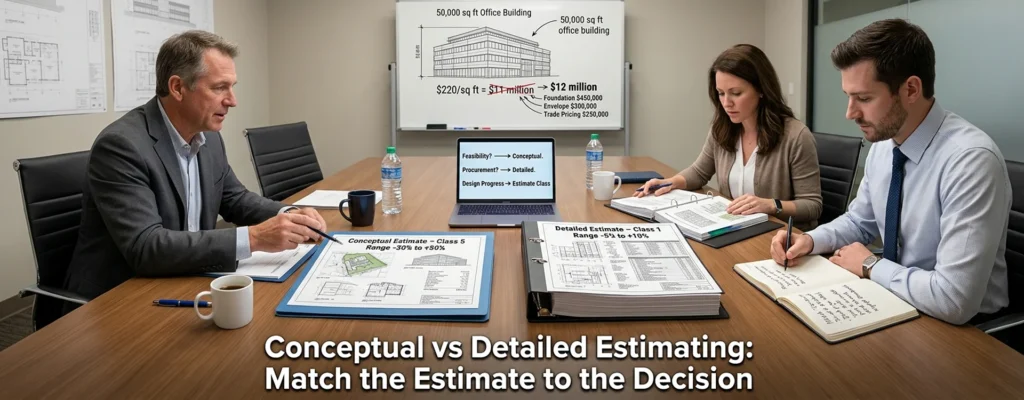
A developer comparing sites needs a different cost answer from one preparing construction contracts. Confusing those decisions can leave you paying for detail too early or committing capital before the budget is dependable. Conceptual vs. detailed estimating isn’t a contest between rough and reliable. It’s about matching the estimate to the decision.
Which Estimate Should You Use? Direct Answer
Use conceptual estimating when you don’t have enough information to make feasibility and site comparisons or preliminary design decisions. If you can measure reliably from clearly defined scopes, coordinated drawings, and up-to-date pricing, use detailed estimating to support procurement decisions and construction budget control.
Estimates are typically prepared using historical comparisons, area rates, and system allowances. A detailed cost estimate gives quantitative costs of actual work items as well as cost rates for labor, material, equipment, and subcontractor supplies. Both require documented assumptions. Neither guarantees the final construction price.
What Changes Between Conceptual and Detailed Estimating?
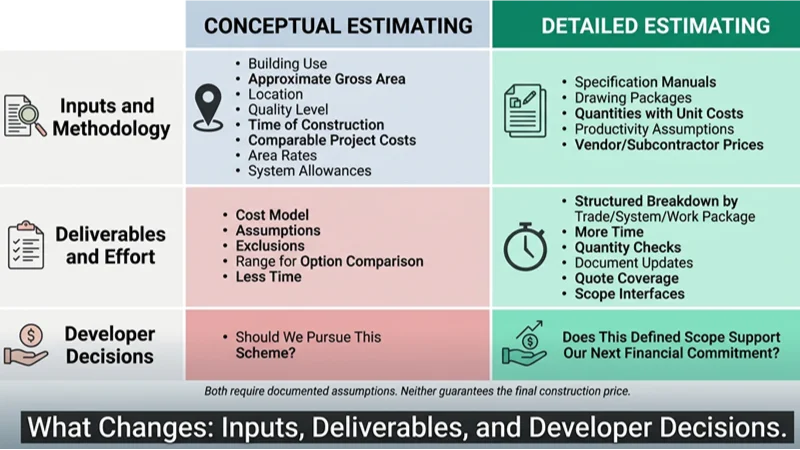
Inputs and methodology
A conceptual estimate may start with the building use, approximate gross area, location, quality level, and time of construction. The estimator changes either the costs of comparable projects or large projects. The work may be defined by the specification manuals and drawing packages. Quantities are assigned unit costs, productivity assumptions, and relevant vendor or subcontractor prices.
Deliverables and effort
Conceptual estimating typically results in a cost model, assumptions, exclusions, and range appropriate for option comparison. A structured breakdown is generated by detailed estimating by trade, system, or work package. This often takes more time because we need to check quantities, document updates, quote coverage, and scope interfaces.
Developer decisions
Use the conceptual model to ask, “Should we pursue this scheme?”
Use the detailed estimate to ask, “Does this defined scope support our next financial commitment?”
Digital estimating & architecture helps developers and contractors match the estimate to the decision.
When conceptual estimating makes sense.
Conceptual estimating earns its stripes before it becomes costly to alter design. It allows for the comparison of development options chosen without any pretense that the unresolved specification is settled.
In a multifamily project, that might mean evaluating surface parking vs. structured parking or evaluating two building configurations. The estimate should reveal the difference’s cause instead of concealing everything in one square foot rate.
A credible starting package includes:
-
Intended use and approximate area.
-
Location and anticipated construction dates.
-
Structural and building services assumptions.
-
Sitework inclusions and known constraints.
- Expectations regarding quality, exclusions, and risk.
Construction cost doesn’t mean total development cost is the same. We must analyze in detail all land acquisition, financing, professional fees, permits, and other owner costs.
How Close to Reality Is a Conceptual Estimate?
The factors that affect the accuracy of a conceptual estimate include scope definitions and relevant data. The label alone does not create a reliable percentage. The construction guidelines of the AACE show the difference. The estimate in a Class 5 estimate is expected to be between minus 30% and plus 50% of the estimate. The Class 1 estimate may only be 5 per cent lower and 10 per cent higher. These are general outer examples, not universal promises. The guidance provides standard levels using an 80% confidence interval after an appropriate contingency for a specified scope.
Specific AACE classes may not automatically substitute for conceptual and detailed ones. Please request that the estimator clarify the classification, supporting deliverables, and project-specific risk assessment. The unspecified issue at the bottom of the structure can’t be solved by simply adding more rows in the spreadsheet.
When an intricate cost evaluation is needed.
When scope allows for meaningful measurement and pricing, valuable detailed estimating is done. It assists in tender evaluation, preparation of procurement, negotiated pricing, and control of construction costs.
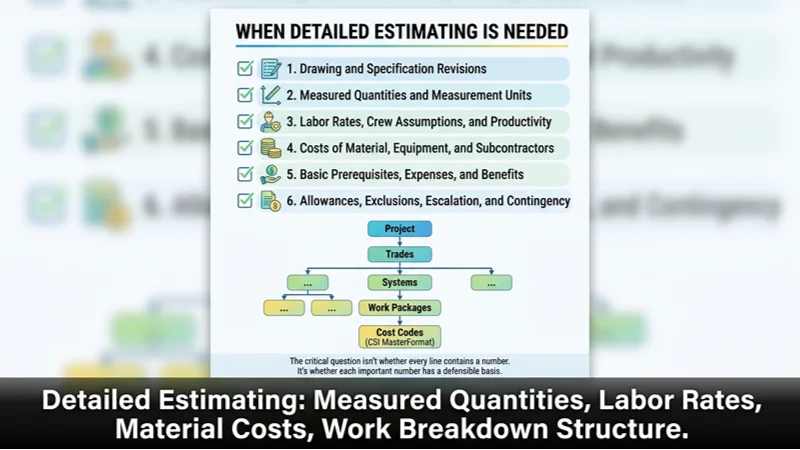
You can expect the estimate to address.
- Drawing and specification revisions.
- Measured quantities and measurement units.
- Labor rates, crew assumptions, and productivity.
- The costs of material, equipment, and subcontractors.
- Basic prerequisites and expenses, as well as benefits.
- Allowances, exclusions, escalation, and contingency.
A Work Breakdown Structure organizes the scope of an activity. If you use consistent cost codes like CSI MasterFormat, the estimate can carry over to procurement and reporting. The critical question isn’t whether every line contains a number. It’s whether each important number has a defensible basis.
A Developer Case: The Reason for the Increase in Budget.
Think of an example of development of 50,000 square feet. Assume a $220 per square foot allowance for early building. That creates $11 million before separately identified sitework, owner costs, and other exclusions. These figures show the methodology; they are not market averages. Recent updates provide $450,000 in foundation needs, $300,000 for envelope improvements, and $250,000 for trade pricing updates. The revised subtotal on a like-scope basis is $12 million.
If we label this as a $1 million estimating error, we hide the reasons. Some of it is due to newly defined conditions, some of it is a design choice, and some of it is a pricing movement. Please ask for the reconciliation to be done for all quantity changes, specification changes, market changes, omissions, and risk allowance changes. That explanation makes the revised budget doable.
When to Switch: Decision-Making Tips.
There’s rarely one clean handover date. Some packages may support detailed estimating while others still need conceptual allowances.
Before upgrading the whole estimate, check whether:
-
Major systems and specifications are sufficiently defined.
-
Site information addresses material cost risks.
-
Drawings are coordinated enough for measurement.
-
Pricing reflects the intended procurement period.
-
Remaining allowances have an owner and resolution date.
Where one unresolved package could change feasibility, investigate that package first. Some additional information may be helpful elsewhere, but not for now.
Recommendations for Cost Estimation Service.
Request a sample deliverable before fee comparison. Please confirm if the scope of the assignment is limited to construction cost or that of the entire development. Please provide a basis of estimate that explains documents reviewed, pricing dates, assumptions, exclusions, and risk treatment. To get an update, we need reconciliation versus the previous budget. A useful service brief is specific: ‘Review our current documents, identify unresolved scope, and recommend the estimating approach appropriate for our next approval.’ That request is more useful than asking for a low price.
Frequently Asked Questions
What is the difference between conceptual and detailed estimating?
Conceptual estimating models costs from limited information. Detailed estimating measures and prices defined work. Their purposes and evidence requirements differ.
Can a conceptual estimate support financing?
It can inform early financing discussions. When a lender feels assured by their specifications, project stage, and documents, they’ll coordinate with you.
Is a detailed estimate only possible once the plans have been finalized?
Not always. The estimation can be done in detail for identified packages that will remain classified as tolerant or qualified.
Is a detailed quote the same as a quotation?
Rejecting. A quantity of measurement. A proposal specifying work and remuneration is termed a bid in business contracts.
Should contingency disappear with design development?
Not by default. The contingency should represent the remaining risk or uncertainty. Better information can mitigate some risks and amplify others.
How Often Should Developers Recast an Estimate?
It’s important to enhance it at critical design milestones and before key commitments. Previous edits may be warranted because of alterations to the materials scope, discoveries at the site, or shifts in procurement timing.
Your Next Action
Build an Estimate Readiness Checker rather than another generic square foot calculator. Ask about the upcoming decision, drawing maturity, site information, specification completeness, and quote coverage. Return a recommended estimating approach, missing information checklist, and suggested next investigation. Present the result as preliminary guidance, not a certified estimate classification.
